Last updated October 15, 2026
The Complete Guide to ADU in Pasadena
Pasadena sits inside one of California’s most permissive ADU climates. The state pre-empted most local restrictions in 2020, which means a homeowner who wants to add a rental unit, a home office, or a place for aging parents is no longer fighting city hall. Yet fewer than 4% of eligible Pasadena lots have added an ADU. The bottleneck isn’t the law. It’s information. This guide maps every fork in the decision tree: zoning overlays, lot dimensions, utility costs, prefab versus site-built, and the exact paperwork that separates a smooth build from a stalled one. By the time you finish reading, you’ll know which questions to ask and which answers should already be in writing before you sign anything.
Quick Answer
An ADU (Accessory Dwelling Unit) in Pasadena is a second, fully independent living unit on a single-family lot, with its own kitchen, bathroom, and entrance. Under California state law, Pasadena must approve ADUs on nearly any residential lot regardless of local zoning, provided the unit meets basic size, setback, and height standards. Most Pasadena ADUs cost between $180,000 and $420,000 all-in depending on type, size, and utility work, and the process from design to certificate of occupancy typically takes 12 to 18 months.
Table of Contents
- The Four ADU Types Allowed in Pasadena
- How Pasadena Zoning Overlays Interact With State ADU Law
- Real Costs in Pasadena That Never Appear in “Starting At” Prices
- Financing an ADU Without Draining Your Savings
- Prefab Versus Site-Built: What Actually Differs in Pasadena
- How to Read a Written Proposal Versus a Verbal Estimate
- The Step-by-Step ADU Timeline in Pasadena
- Common Mistakes to Avoid
- When to Call a Professional
- Frequently Asked Questions
- The Bottom Line
The Four ADU Types Allowed in Pasadena
Pasadena follows California’s statewide ADU framework, which recognizes four distinct unit types. Each one has different size caps, setback rules, and cost profiles. Choosing the wrong type for your lot is the single most common planning mistake we see.
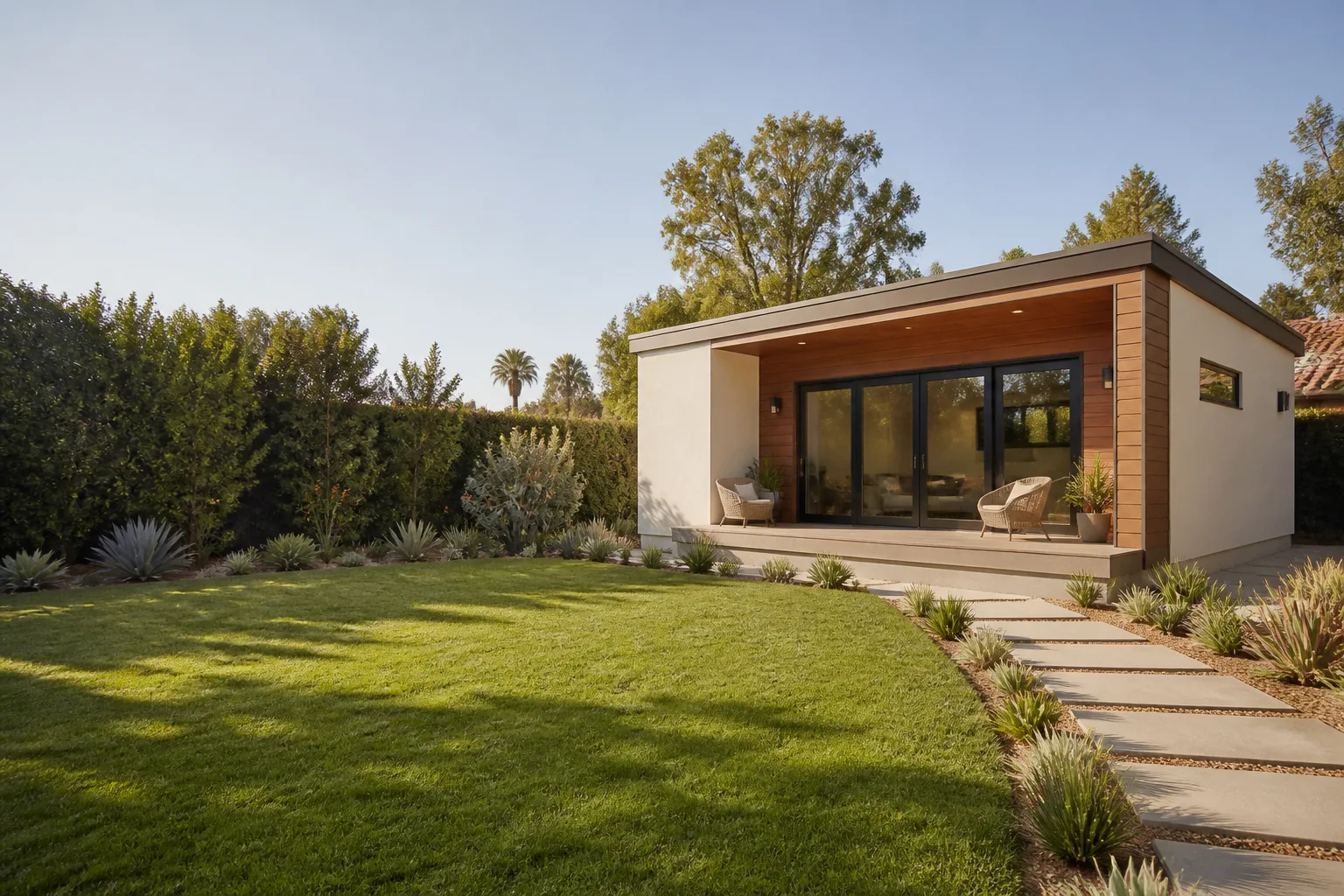
- Detached ADU: A standalone structure separate from the main house. In Pasadena, a detached ADU can reach 1,200 square feet on most single-family lots, with a 4-foot rear and side setback requirement. This is the most flexible option for rental income because it gives tenants their own front door and yard separation. Cost range: $250,000 to $420,000.
- Attached ADU: A unit built onto or inside the footprint of the existing house, sharing at least one wall. Attached ADUs follow the same 1,200-square-foot maximum but must comply with the primary structure’s setback rules. They’re popular in Pasadena’s Craftsman neighborhoods where owners want the unit to read as a natural extension of the house. Cost range: $180,000 to $320,000.
- Garage Conversion: Converting an existing garage into a living unit. This is often the most affordable path because the structure already exists, but Pasadena requires that any converted garage be replaced with covered parking or the lot must qualify for an exemption. Cost range: $120,000 to $220,000, plus the cost of any replacement parking structure.
- JADU (Junior ADU): A unit of up to 500 square feet created entirely within the walls of the existing house, often by converting a bedroom with an attached bath or adding a small kitchenette. JADUs are the cheapest entry point at $70,000 to $140,000, but they’re designed for family use, not rental income, because the owner must live on the property.
For most Pasadena homeowners weighing rental income against upfront cost, a detached ADU under 800 square feet offers the strongest return. It rents independently, keeps tenant and landlord spaces separate, and avoids the parking replacement trigger that garage conversions face.
How Pasadena Zoning Overlays Interact With State ADU Law
State law is clear: Pasadena cannot deny an ADU permit because of lot size, floor area ratio, or coverage limits, with one exception for historic districts. But Pasadena’s local overlays still shape the build in ways that never show up in generic ADU guides.
Three overlays matter most:
- Hillside Overlay: Much of Pasadena north of the 210 Freeway falls under hillside development rules. These add grading requirements, soil reports, and sometimes view protection analysis. Hillside lots also trigger stricter fire zone setbacks. A hillside ADU in neighborhoods like Linda Vista or San Rafael typically costs 15 to 25% more than the same unit on flat land.
- Historic Districts: Pasadena has 19 landmark districts, including Bungalow Heaven, Madison Heights, and Orange Heights. State law says cities must approve ADUs even in historic areas, but Pasadena’s design review can require specific window proportions, rooflines, and materials so the unit doesn’t visually disrupt the district’s character. This adds design time but rarely blocks a project outright.
- R-1 and R-2 Zoning: Most single-family lots in Pasadena are zoned R-1, where both an ADU and a JADU are allowed on the same property. R-2 lots, more common in the city’s denser center, may qualify for up to two ADUs. Understanding your specific zoning designation before you design is critical; it determines square footage caps and whether a second unit is even possible.
Where homeowners get tripped up: Pasadena requires a pre-application plan check for most ADUs, and that’s where overlay issues surface. Hillside grading reviews and historic district design comments can add 60 to 90 days to the timeline. We recommend checking your property’s zoning and overlay status on the city’s parcel map before spending money on architectural drawings.
Real Costs in Pasadena That Never Appear in “Starting At” Prices
A contractor’s “starting at” price for an ADU is the construction cost only. It leaves out the line items that routinely add $40,000 to $80,000 to a Pasadena project. Here’s what actually shows up on the final invoice:
- Water and sewer connection fees: Pasadena Water and Power charges connection fees based on meter size and fixture count. Expect $5,000 to $15,000 depending on whether you’re tapping an existing lateral or running a new line from the street.
- Electrical panel upgrade: Many Pasadena homes built before 1980 have 100-amp panels. An ADU with a kitchen and laundry typically requires 200-amp service or a subpanel. Budget $3,000 to $8,000 for the panel swap plus any trenching.
- Site preparation and foundation: Flat lots in central Pasadena are straightforward, costing $15,000 to $30,000 for excavation and a slab or pier foundation. Hillside lots can double that once retaining walls and drainage engineering enter the picture.
- Permit and plan check fees: Pasadena’s building permit fees for ADUs run $8,000 to $15,000, with additional fees for school district impact, utility inspections, and any planning review triggered by overlays.
- Architectural and engineering drawings: $10,000 to $25,000 for full plans, structural calculations, and Title 24 energy compliance reports.
- Utility trenching: If your gas, electric, or sewer lines need to run across the yard to reach the ADU, trenching costs $50 to $120 per linear foot in Pasadena’s clay-heavy soil.
Run the numbers before you sign any contract. A $220,000 site-built ADU with a $45,000 utility and site work package is a $265,000 project. The written proposal should already show this.
Financing an ADU Without Draining Your Savings
Most Pasadena homeowners finance an ADU through one of four paths. None of them are wrong, but each one changes the math.
- Cash-out refinance: If you bought before 2021 and have meaningful equity, a cash-out refinance locks in a long-term fixed rate. This makes sense when your current mortgage rate is below market.
- HELOC or home equity loan: A line of credit gives you flexibility to draw only what the project needs as it progresses. Rates are higher than a first mortgage but closing costs are lower.
- Construction-to-permanent loan: These loans finance the build and then convert to a standard mortgage when the ADU is complete. Lenders underwrite the future rental income, which means a $2,000 monthly rent projection can qualify a project that otherwise wouldn’t pencil.
- Cash savings: For smaller JADUs and garage conversions under $150,000, paying cash avoids interest entirely and keeps the process simple. But it concentrates risk if the project runs over budget.
- Speed: Factory construction eliminates weather delays. Pasadena’s dry season from May to October helps site-built projects, but prefab doesn’t care about rain.
- Price certainty: Prefab pricing is fixed at the factory level. There’s no scope creep on framing or drywall because those stages happen off-site.
- Quality control: Factory tolerances are tighter than what most field crews achieve, especially for air sealing and insulation.
- Site access: Many Pasadena homes on narrow lots or tucked behind mature trees can’t accommodate the crane or flatbed delivery prefab requires.
- Design flexibility: Site-built ADUs can match a Craftsman roofline or a mid-century flat roof with more precision than a prefab’s standard models.
- Custom foundations: Hillside lots in Pasadena sometimes need stepped footings or retaining walls that prefab systems don’t accommodate easily.
- A line-item scope of work: Every phase listed separately, from demolition and excavation to framing, rough-in, finishes, and site cleanup. If a phase is missing, the contractor can bill it as a change order later.
- A fixed price or clearly defined allowances: A fixed price means the number doesn’t move unless the scope changes. Allowances are budgets for items like tile or fixtures that get chosen later. Both are legitimate, but allowances should have explicit ceilings.
- A payment schedule tied to milestones: Never pay more than 10% upfront or 1% more than 10% for a project exceeding $1,000 in California. Progress payments should correspond to completed phases, not arbitrary dates.
- Permit responsibility: The proposal should state who pulls permits, who schedules inspections, and what happens if the city requests corrections.
- Warranty terms: State law requires a one-year warranty on new construction, but it should be in writing, not assumed.We include the 365-Day Done Right Promise printed on every proposal, which means if any covered work fails within a year, we fix it.
- Change order process: The document should explain how changes are priced, approved, and documented. Verbal change orders are the fastest way to a $20,000 surprise.
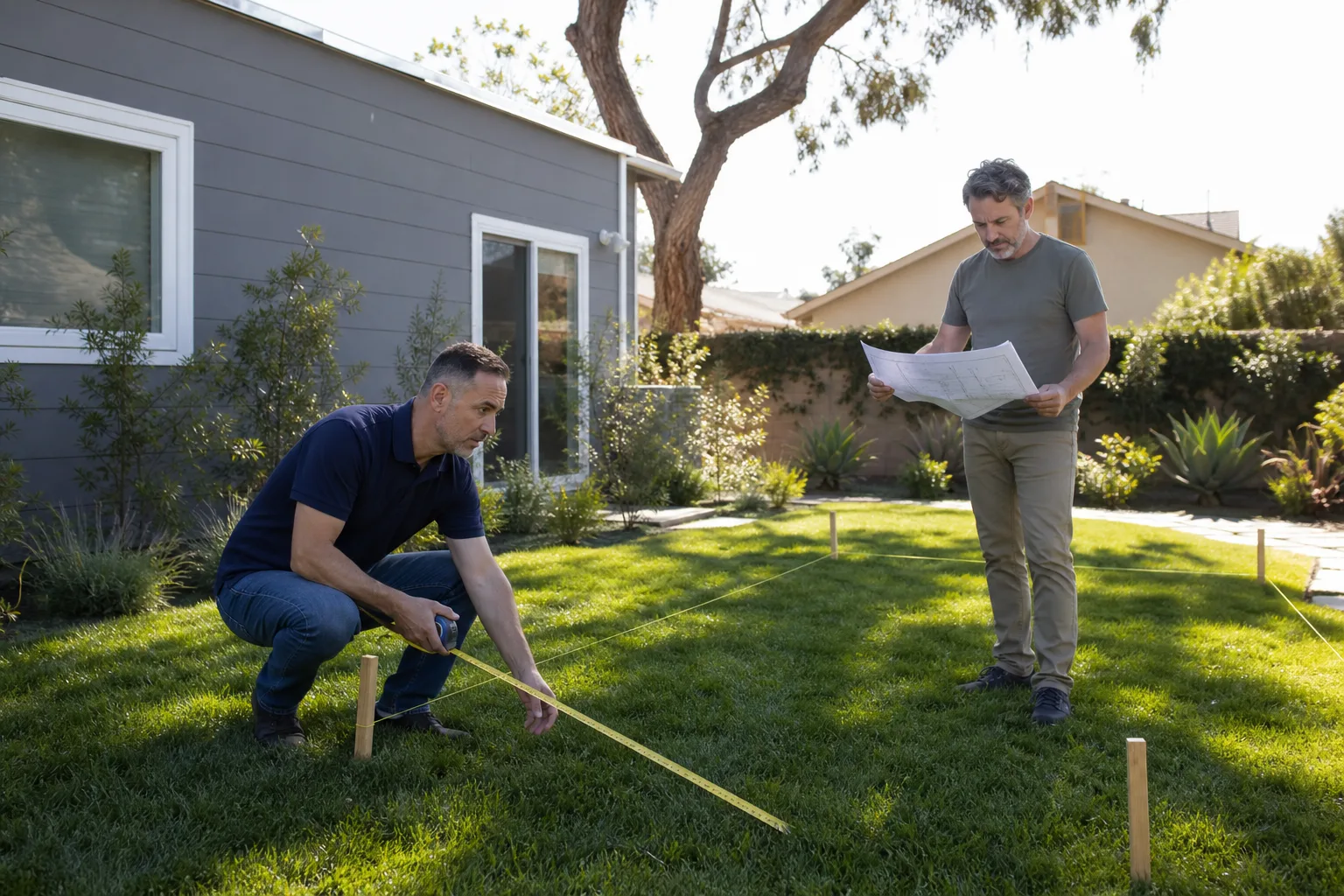
- Feasibility check (2 to 4 weeks): Verify zoning, overlays, lot dimensions, and utility capacity. Order a sewer lateral inspection and an electrical load calculation. This is where you discover the panel upgrade or the collapsed sewer line before you’ve paid for drawings.
- Design and engineering (4 to 8 weeks): Your architect or designer produces plans, structural engineer stamps them, and a Title 24 energy consultant prepares the compliance report. Prefab projects skip most of this phase because the manufacturer holds pre-approved plans.
- Permit submittal and plan check (6 to 12 weeks): Pasadena’s Building and Safety Division reviews plans for code compliance. Historic districts add a design review step that runs parallel.This is the timeline phase with the most variability.
- Permit issuance (1 to 2 weeks): Once plan check corrections are resolved and fees are paid, the permit is issued and construction can begin.
- Site work and foundation (2 to 4 weeks): Excavation, grading if required, formwork, concrete pour, and curing. Utility trenching happens in this window.
- Framing, rough-in, and exterior (6 to 10 weeks for site-built; 1 to 2 weeks for prefab): Structure goes up, then plumbing, electrical, and HVAC rough-in, followed by exterior weatherproofing and cladding.
- Interior finishes (4 to 8 weeks): Drywall, paint, flooring, cabinets, countertops, fixtures, and appliances.
- Final inspections and occupancy (2 to 4 weeks): Pasadena performs final building, electrical, plumbing, and mechanical inspections. Once passed, you receive the certificate of occupancy and can legally rent the unit.
- Designing before checking utility capacity: A 1200-square-foot ADU with a kitchen, bathroom, and laundry will likely require an electrical panel upgrade. Discovering this after the design phase means redrawing electrical plans and paying for a second plan check.
- Ignoring the sewer lateral: Pasadena’s older homes frequently have clay sewer lines that have shifted or cracked. A new ADU adds fixture units to a line that may already be near capacity. A $3,000 sewer camera inspection before design can prevent a $20,000 line replacement mid-construction.
- Assuming the garage conversion saves the parking requirement: Pasadena enforces replacement parking for converted garages unless the lot qualifies for a specific exemption. Verify this before you commit to the cheapest ADU path.
- Skipping the pre-application meeting with the city: Pasadena offers a pre-application plan check for ADUs. Fifteen minutes with a plans examiner can surface overlay issues, fire zone requirements, or setback interpretations that would otherwise stall the permit for months.
- Signing a contract without a written change order clause: Verbal agreements on a construction site have a way of becoming $15,000 additions. The change order process should be in the original contract, in writing, with clear pricing rules.
- Underestimating the site work budget: Flat-lot construction is cheap. Pasadena’s hillside lots are not. Grading, retaining walls, drainage, and fire zone setbacks add five figures to a hillside ADU. Price the site before you price the structure.
- Choosing a contractor based on the lowest bid without checking warranties: The cheapest bid often excludes site work, permits, or a meaningful warranty. Compare the full written scope, not the bottom-line number.
Pasadena’s strong rental market supports ADU financing. A one-bedroom detached unit in neighborhoods like Playhouse District, Washington Square, or Normandie Heights rents for $1,800 to $2,600 per month. At those rates, a $280,000 ADU financed at 7% over 30 years carries a monthly payment around $1,860. The rental income covers the loan in most scenarios.
For a deeper look at how construction contracts are structured, see our guide on ADU Builders in Pasadena.
Prefab Versus Site-Built: What Actually Differs in Pasadena
Pasadena homeowners now have a real choice between panelized prefab ADUs and traditional site-built construction. The difference isn’t quality. It’s timeline, finish control, and site conditions.
Prefab brands like Abodu and Cover manufacture panels in a controlled factory, ship them to the site, and assemble the unit in days rather than months. Abodu’s one-bedroom, one-bath units compact the entire construction timeline into roughly 12 to 16 weeks from foundation pour to move-in, compared to 6 to 9 months for site-built. Dvele builds larger prefab homes with integrated smart-home systems and stronger energy performance, which matters in Pasadena’s hot summers and cool winter nights.
Where prefab wins:
Where site-built wins:
Both paths produce livable, rentable units. The real question is whether your lot, your timeline, and your aesthetic priorities favor one route. Benson ADU Pasadena builds with both approaches, which means the conversation starts with your property’s constraints, not a sales pitch for a single product. Learn more about how we approach these projects on our Benson ADU Pasadena home page.
How to Read a Written Proposal Versus a Verbal Estimate
A verbal estimate is a number spoken out loud. A written proposal is a document you can enforce. In Pasadena, where an ADU is a six-figure investment, the difference matters more than any design choice.
Here’s what a legitimate written proposal includes:
If a contractor in Pasadena won’t put the number in writing, walk away. That’s not negotiable on a project this size. Our team provides a written price before any work starts, which is what you should expect from any builder worth considering. If you’re also thinking about expanding the main house, read our guide on home additions in Pasadena for the same principle applied to larger projects.
The Step-by-Step ADU Timeline in Pasadena
Every ADU in Pasadena follows the same regulatory sequence. The timeline below assumes a straightforward flat-lot project with no historic overlay complications.
Total elapsed time for a site-built ADU in Pasadena: 12 to 18 months. Prefab projects can shave 4 to 8 months off the schedule because design and plan check happen concurrently with factory production. Neither path is fast. Both reward planning.
Common Mistakes to Avoid
When to Call a Professional
An ADU is not a project you should manage without experienced help. The permit sequence alone involves structural calculations, energy compliance, and inspections that most homeowners navigate once in a lifetime. You’ll want a builder involved from the feasibility stage, not after you’ve already spent money on drawings that don’t work for your lot. See our guide on How to Hire a ADU Contractor in Pasadena: A Step-by-Step Guide for what to look for. If your property sits in a hillside overlay, a historic district, or has utility infrastructure more than 40 years old, professional evaluation is genuinely necessary before you commit to a design. Benson ADU Pasadena offers free estimates for homeowners in Pasadena, so you never pay to learn your options. Call (626) 658-3527 to schedule yours.
Frequently Asked Questions
An ADU in Pasadena typically costs between $180,000 and $420,000 all-in, including construction, utility connections, permits, and site work. Detached units run $250,000 to $420,000, attached units $180,000 to $320,000, garage conversions $120,000 to $220,000, and JADUs $70,000 to $140,000. These figures include Pasadena-specific costs like connection fees and seismic requirements. Call (626) 658-3527 for a free written estimate tailored to your property.
Pasadena allows detached and attached ADUs up to 1,200 square feet on single-family lots. JADUs are capped at 500 square feet. State law also permits an 800-square-foot ADU regardless of local floor area ratio limits, which is why most Pasadena homeowners build units in the 600 to 800 square foot range.
In most cases, yes. Pasadena requires covered parking replacement when a garage is converted to living space, unless the property qualifies for a state-law exemption such as being within a half-mile of a transit stop or having an existing carport. This requirement can add $15,000 to $30,000 to a garage conversion project.
A site-built ADU in Pasadena takes 12 to 18 months from design to certificate of occupancy. Prefab ADUs, including brands like Abodu and Cover, can complete the same process in 8 to 12 months because plan check and factory production run concurrently. The biggest variables are city plan check timing and any historic district or hillside overlay reviews.
Yes, both attached and detached ADUs can be rented in Pasadena for terms of 30 days or longer. Short-term rentals under 30 days are prohibited for ADUs. JADUs must be owner-occupied, meaning the property owner must live in either the main house or the JADU, which effectively excludes JADUs from rental use.
Yes. When you build with Benson ADU Pasadena, we prepare the plans, submit the permit application, coordinate with Pasadena’s Building and Safety Division, and schedule every inspection through final sign-off. You never touch a single form. Reach our live team at (626) 658-3527 any time, day or night, to get started.
The Bottom Line
Building an ADU in Pasadena is a decision tree with branches at every step: which of the four types fits your lot, whether a hillside or historic overlay changes the rules, what your utility infrastructure can support, which construction method aligns with your timeline, and how the contract protects you once work begins. The law is on your side. State preemption means Pasadena can’t deny a compliant ADU application. But the law doesn’t write your contract, price your utility connections, or flag that collapsed sewer lateral before it becomes a change order. For ongoing maintenance after construction, review our Seasonal ADU Care for Pasadena: Year-Round Homeowner’s Guide. That’s where a written proposal, a documented warranty, and a builder who answers the phone make the difference. If you’re ready to see what your Pasadena lot can support, call Benson ADU Pasadena at (626) 658-3527 for a free estimate. The plan and the price go in writing before anything else happens.
Written by Troy Eastman, Owner at Benson ADU Pasadena, serving Pasadena since 2006.