Last updated October 15, 2026
ADU Warning Signs: A Pasadena Homeowner’s Reference Guide
Here’s a counterintuitive fact we’ve learned from years of building accessory dwelling units: the most expensive ADU mistake in Pasadena doesn’t happen during construction. It happens at the kitchen table when a homeowner signs a contract that has no line-item price breakdown and a vague “completion” clause. By the time the framing goes up, the damage is already done. This guide walks you through the warning signs that show up early, during contractor selection and design, when you still have leverage to walk away and find a builder who puts everything in writing before the first shovel turns. For a deeper dive, see The Complete Guide to ADU in Pasadena.
Quick Answer
The biggest ADU warning signs in Pasadena show up before construction starts: contracts with “allowances” instead of fixed line-item prices, permit promises without specifics on which permits get pulled, plans that ignore your parcel’s setback math, and prefab brand claims the contractor can’t back up with a documented installer relationship. If a contractor can’t give you a written price before work starts, that’s the red flag that predicts every other problem down the line.
Table of Contents
- Contract Red Flags Most Homeowners Miss
- Permit Red Flags: When “We’ll Handle It” Means “You’ll Deal With It Later”
- Design Red Flags That Show Up Before Anyone Swings a Hammer
- Prefab Red Flags: Verify the Brand Relationship Before You Sign
- Pricing Red Flags and the Allowance Trap
- Post-Build Warning Signs You Should Never Ignore
- A 10-Point Contractor Vetting Checklist
- Common Mistakes to Avoid
Contract Red Flags Most Homeowners Miss
Most ADU contracts in Pasadena aren’t read closely enough. Homeowners skim the price line, check the timeline, and sign. That’s what the “allowances” and “plus site conditions” clauses are counting on. Here’s what those terms actually mean and how they get used to inflate your final bill.
An allowance is a placeholder dollar amount the contractor puts in the contract for items they haven’t priced yet. It sounds reasonable: “Flooring allowance: $4,000.” But an allowance is not a real price. It’s a guess, and it’s almost always a low guess. When the actual materials get selected, the real bill lands higher, and you’re already locked into the contract. A $4,000 flooring allowance on a 600-square-foot ADU in Pasadena routinely ends up at $6,500 or more once you pick a mid-range product and factor in installation. The contractor isn’t losing money. You’re paying the difference.
The “plus site conditions” clause is even more common and even more open-ended. Contractors insert language that lets them bill extra if they discover “unforeseen conditions” once work begins: rockier soil than expected, an old sewer line in the wrong spot, a tree root where the foundation goes. Some of that is legitimate; construction does have surprises. But without a cap on what “site conditions” can add, that clause is a blank check. We’ve seen Pasadena homeowners hit with $18,000 in extra charges after a contractor invoked site conditions for soil that a proper pre-construction survey would have flagged on day one.
What to look for instead: a fixed-price contract with line-item detail for every phase, from demolition through final paint. At ADU Builders in Pasadena, we follow a different standard: a written price before any work starts, with no scope creep billed after the fact. That’s the Relay Visibility Guarantee, and it’s in writing on every project. If a contractor won’t put a line-item price in front of you before you sign, treat that as the first red flag and the only one you really need.
The completion date clause matters just as much as the price. A contract that says “completion in approximately 120 days” with no definition of what happens when day 121 arrives is a one-sided agreement. Ask for a defined completion window and a written remedy if it’s missed. If the contractor balks at writing either one down, that tells you everything about how the final six weeks of the project will go.
Permit Red Flags: When “We’ll Handle It” Means “You’ll Deal With It Later”
Pasadena has some of the most specific ADU permitting requirements in Los Angeles County, and the rules changed meaningfully in 2023 and 2024. A contractor who waves a hand and says, “We’ll handle all the permit stuff,” without telling you exactly which permits are being pulled is creating a liability for you, not removing an inconvenience from your plate.
Here’s the core problem: the permit belongs to the property owner, not the contractor. If permits aren’t pulled or inspections aren’t scheduled properly, the city comes after you. You’re the one with an unpermitted structure on your deed, which becomes a nightmare if you ever refinance, sell, or file an insurance claim. A contractor who treats permits as an afterthought is transferring risk to you without saying so out loud.
Permit red flags to watch for:
- Contractor can’t name the specific permit types your ADU requires: building, electrical, plumbing, mechanical, and possibly a separate grading or sewer connection permit depending on your parcel.
- They suggest skipping permits to save money or speed up the timeline. In Pasadena, unpermitted ADUs are becoming easier for the city to detect through satellite imagery and utility data, and the cure is more expensive than the permit ever was.
- The contract doesn’t state who schedules inspections and who is responsible if an inspection fails. Failed inspections cost time and money, and the contract should be explicit about which party absorbs that cost.
- They can’t explain how Pasadena’s ADU ordinance applies to your specific property: setback requirements, height limits, parking rules, and whether your lot is in a hillside zone with additional geological review.
What a responsible contractor does instead: names the permits, explains the timeline for each, confirms inspections are scheduled and tracked, and provides you with copies of every permit and inspection record. We’ve built enough ADUs in Pasadena to know that the permit conversation is where homeowners get their first honest look at how a contractor operates. Ask for a permit schedule in writing. If the answer is vague, walk.
Design Red Flags That Show Up Before Anyone Swings a Hammer
ADU design drawings look impressive on paper. But a plan that renders beautifully and builds badly is worse than no plan at all. Two specific design omissions predict most construction-phase problems in Pasadena: missing utility connection strategies and setback math that doesn’t match the actual parcel.
Utility connection strategy. Every ADU needs water, sewer, electrical, and often gas connections. A plan that shows the ADU footprint and floor layout but doesn’t show how utilities get from the main house to the new unit is an incomplete plan. Where does the sewer line run? Does it need a new trench through the backyard, under a patio, or around a mature tree? What’s the distance from the main electrical panel to the ADU subpanel, and is the existing panel even big enough to carry the additional load? In Pasadena, many older homes have 100-amp panels, and an ADU with a kitchen, HVAC, and laundry often requires a 200-amp upgrade. If the designer didn’t flag that at the drawing stage, you’ll discover it mid-construction, when the fix is a $4,000 to $6,000 surprise instead of a planned budget line.
Setback math. Pasadena’s setback requirements vary by zone, and a plan drawn for a “typical” lot often doesn’t fit yours. An ADU that sits two feet from the rear property line might be perfectly legal on one parcel and two feet too close on the next one. The same applies to side yard setbacks and the distance between the ADU and the main house. Hillside parcels add another layer: geological review and additional grading requirements that flat-lot plans ignore. If the contractor presents a plan without referencing your specific parcel’s setback and zoning data, that plan is a brochure, not a buildable design.
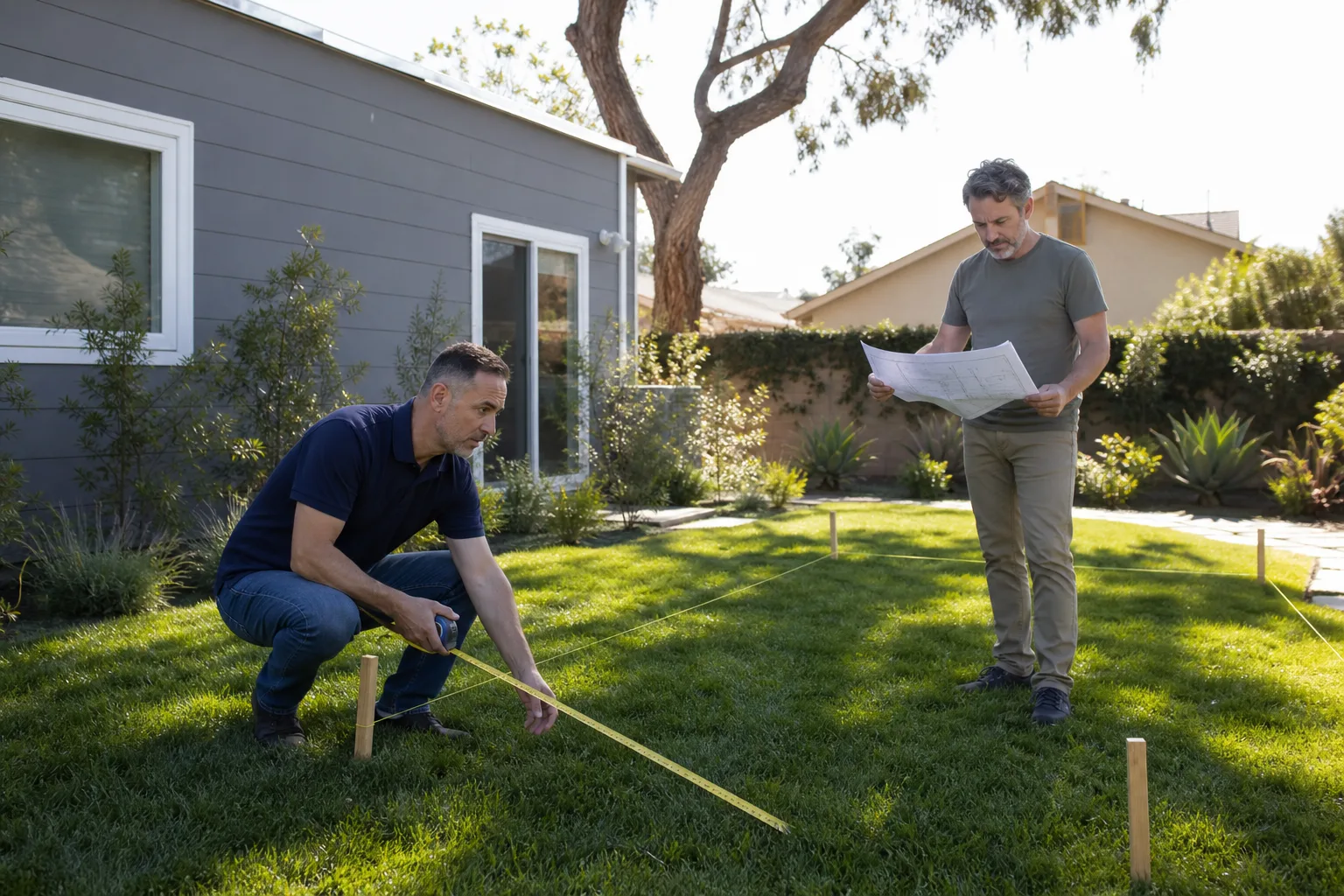
Ask to see the site plan with the property lines drawn to scale, the setbacks dimensioned, and the utility routes marked. If the contractor can’t produce that before you sign, you’re buying a concept, not a plan.
Prefab Red Flags: Verify the Brand Relationship Before You Sign
Prefab ADUs have become genuinely attractive in Pasadena: faster construction, less site disruption, and factory-level quality control on the structural shell. Brands like Abodu, Plant Prefab, and Dvele have built strong reputations, and that’s exactly why some contractors borrow their names without having any real relationship with them.
The red flag phrase is: “We work with all the big prefab brands.” What that often means is: “We’ll figure out how to get one installed after you sign.” A legitimate prefab ADU build requires the contractor to be an authorized installer or have a documented relationship with the specific brand: factory specs, panel tolerance data, integration training, and a direct line to the manufacturer’s engineering team. Without that, you get a general contractor improvising an install on a product they’ve never touched.
How to verify a prefab claim:
- Ask the contractor to name the specific brands they’re authorized to build with. “We work with everyone” is not an answer.
- Ask for proof of the installer relationship: authorization letters, training certificates, or direct contact information for the manufacturer’s rep.
- Call the manufacturer yourself. Abodu and Plant Prefab both maintain lists of authorized builders, and they’ll tell you directly whether a contractor is on it.
- If the contractor deflects, changes the subject, or says “it’s basically the same as site-built,” that’s your answer. Prefab is not the same as site-built, and pretending it is signals either dishonesty or inexperience.
One more point that matters even if you’re not considering prefab: the same verification standard applies to materials claims. If a contractor says they use James Hardie cladding, that’s checkable. James Hardie publishes its certified partners. The same goes for Tuff Shed structures used as studio ADUs. A real relationship is verifiable. A fake one dissolves the moment you ask.
Pricing Red Flags and the Allowance Trap
Pasadena ADU pricing is not a mystery. Good contractors can give you a firm range before you sign, based on the size of the unit, the access to the build site, and the complexity of the utility connections. The contractors who won’t give you a number are the ones to avoid.
Here’s what real ADU pricing looks like in Pasadena, based on current market costs:
- Prefab ADU (studio, 350-500 sq ft): $150,000-$220,000 installed, depending on brand and site preparation work. Abodu’s core models and Plant Prefab’s standard designs fall in this range.
- Site-built one-bedroom ADU (600-700 sq ft): $180,000-$280,000, including utility connections, permits, and finishes at a mid-range spec.
- Two-bedroom ADU (800-1,000 sq ft): $250,000-$380,000, with the range driven by foundation conditions, panel upgrades, and finish level.
- Garage conversion to ADU: $120,000-$200,000 depending on the condition of the existing slab and framing.
Those are honest ranges, and they’re broad for a reason: every parcel is different. But a contractor who won’t commit to a range at all, before you’ve paid for design work, is playing a different game. They’re hoping you’ll fall in love with the drawings and accept whatever the final number becomes.
The allowance trap compounds this problem. A contract with $45,000 in allowances across flooring, fixtures, appliances, and finishes gives the contractor permission to discover the real price after you’re already committed. Fixed line-item pricing takes longer to prepare, and that’s exactly why some contractors skip it. Insist on it anyway. At Benson ADU Pasadena, we write the price down before work starts, line by line, and we don’t send change orders after the fact. The written price is the price, and the 365-Day Done Right Promise means we stand behind the work for a full year in writing, not as a handshake.
Post-Build Warning Signs You Should Never Ignore
If your ADU was built by a contractor who cut corners during the phases covered above, the evidence shows up within the first year. These are the three post-build warning signs that indicate installation shortcuts, and none of them should be ignored.
Moisture intrusion patterns. Look for water staining at the base of exterior walls, bubbling paint, or discoloration around window frames and door thresholds. In Pasadena’s dry climate, homeowners sometimes dismiss small leaks because it “barely rains,” but the occasional heavy winter storm is when bad flashing and unsealed penetrations reveal themselves. A unit that shows moisture staining after the first rainy season has a waterproofing problem, and it gets exponentially more expensive to fix the longer it sits.
HVAC short-cycling. If the mini-split or heat pump turns on and off every few minutes instead of running in longer cycles, that’s short-cycling. It usually means the system is oversized for the space, the thermostat is positioned wrong, or the ductless unit was installed without proper load calculations. Short-cycling burns more electricity, wears out the compressor years early, and never controls humidity properly. An ADU in Pasadena should be able to hold a comfortable temperature without constant cycling, even during August heat.
Soft spots in floors. Engineered floor systems, whether prefab panels or site-built joists, should feel solid underfoot. A bounce or soft spot, especially near doorways or where the floor meets the wall, signals subfloor issues: improper fastening, missing blocking, or a moisture problem already degrading the panels. You’ll feel it before you see it. Walk the unit barefoot and pay attention to any give in the floor. It should feel like the main house, not a boat deck.
These three warning signs share a common root cause: installation shortcuts that happened months before, during phases the homeowner couldn’t see. The only real defense is what happens before construction starts: a written contract, verified permits, and a builder who does the invisible work correctly because the visible work is what they’re judged on.
A 10-Point Contractor Vetting Checklist
Print this list and use it before you sign anything. It takes 20 minutes and saves months of regret.
- Written line-item price before any work starts. If the contractor won’t commit to fixed pricing, the final bill will be higher than whatever number they’re willing to say out loud.
- Named permit types and a written inspection schedule. “We’ll handle permits” without specifics is a liability transfer, not a convenience.
- Site plan drawn to scale with setbacks dimensioned for your specific parcel. If the plan doesn’t reference Pasadena’s setback math for your zone, it’s conceptual art.
- Utility connection strategy on the drawing. Sewer route, water tap, electrical load calculation, and panel upgrade (if needed) all identified before construction.
- Verifiable prefab or materials brand relationships. If they claim Abodu or James Hardie, call the manufacturer and confirm the contractor is authorized.
- Defined completion window with a written remedy for overruns. “Approximately” is not a commitment.
- References from completed ADU projects in Pasadena. Ask specifically for projects completed in the last 24 months, and call the homeowners.
- Insurance certificates naming you as additionally insured. Not just “we’re insured.” The actual certificate, sent by the insurance company.
- Written warranty with a defined scope and duration. A 365-Day Done Right Promise is the standard we hold ourselves to. Ask what theirs is.
- Background-checked, uniformed crew. You should know who’s walking onto your property, and they should look like professionals, not strangers.
Common Mistakes to Avoid
- Signing the first contract you’re offered. Get three written bids in Pasadena, and compare them line by line, not just on the bottom number. The low bid is often the most expensive one by the end.
- Paying a large deposit before permits are pulled. California law limits contractor down payments to 10% or $1,000, whichever is less. Anyone asking for 30% or 50% upfront is operating outside the law.
- Believing “we work with all the prefab brands” without verification. Abodu, Plant Prefab, and Dvele all maintain authorized builder lists. Check them.
- Skipping a soils report to save money. In Pasadena’s varied geology, from alluvial flats to hillside fill, the soils report is what keeps “unforeseen site conditions” from becoming a project-ending surprise.
- Not asking about the 200-amp electrical question. If your main panel is 100 amps and the contractor doesn’t mention an upgrade during design, they haven’t actually done the load math.
- Choosing a contractor who won’t give arrival times or show work photos. The Relay Visibility Guarantee exists because homeowners deserve real-time tracking and before-and-after photos. If a contractor can’t tell you when their crew will show up, that’s a process problem, not a one-off.
- Ignoring your gut on the first call. If the contractor is vague on pricing, vague on permits, and vague on timeline in the first conversation, that vagueness compounds with every passing week.
One more mistake, and it’s the most Pasadena-specific one: assuming city rules are the same as neighboring communities. Pasadena’s ADU ordinance has its own setbacks, height limits, and review processes. A contractor who works mostly in other cities and “knows the general rules” is not the same as one who builds here regularly. Ask how many Pasadena ADUs they’ve completed in the last two years. The number should be specific and recent.
When to Call a Professional
You should call a professional the moment you start seriously considering an ADU, not after you’ve already signed a contract with someone else. Not sure how to evaluate one? Read How to Hire a ADU Contractor in Pasadena: A Step-by-Step Guide first. The first conversation is when you learn whether a builder answers pricing questions directly, names specific permits, and puts commitments in writing. If you’ve already signed a contract and spotted any of the red flags in this guide, call a second builder for an independent assessment before more money changes hands. Benson ADU Pasadena offers free estimates in Pasadena, and we’ll walk through your existing plans or help you start fresh. Call (626) 658-3527 to schedule yours.
Frequently Asked Questions
A Pasadena ADU typically costs between $120,000 and $380,000 depending on size, construction method, and site conditions: garage conversions start around $120,000, prefab studios run $150,000 to $220,000, and site-built two-bedroom units reach $380,000. The key is getting a written line-item price before you commit, not an allowance-based estimate that drifts upward. Call (626) 658-3527 for an exact quote on your specific parcel – estimates are free.
An allowance is a placeholder dollar amount for items the contractor hasn’t priced yet, and it almost always comes in lower than the final cost. When the actual materials get selected, you pay the difference, and you’re already locked into the contract. Insist on fixed line-item pricing instead of allowances.
Yes, a site plan with your specific parcel’s setback dimensions drawn to scale is essential, because Pasadena’s setback requirements vary by zone and a generic plan often doesn’t fit your lot legally. Without a parcel-specific site plan, you’re signing a contract for a building that may not be approvable as drawn.
Call the manufacturer directly: Abodu, Plant Prefab, and Dvele all maintain lists of authorized builders and installers, and they’ll confirm whether a specific contractor is on it. If the contractor won’t provide a verifiable relationship, find another builder. Call (626) 658-3527 to talk through prefab options with someone who can document the brand relationships.
The most common post-build problems are moisture intrusion around windows and door thresholds, HVAC short-cycling from improper sizing or installation, and soft spots in engineered floors from subfloor shortcuts. All three trace back to installation quality during construction, which is why a written warranty matters. Benson ADU Pasadena backs every project with a 365-Day Done Right Promise in writing.
Expect 4 to 8 months from contract signing to final inspection for most ADUs, with prefab units on the faster end and site-built on the longer end depending on permits, site conditions, and scope. The contract should define a completion window and a written remedy for overruns before you sign. We put the timeline in writing on every project, just like the price.
The Bottom Line
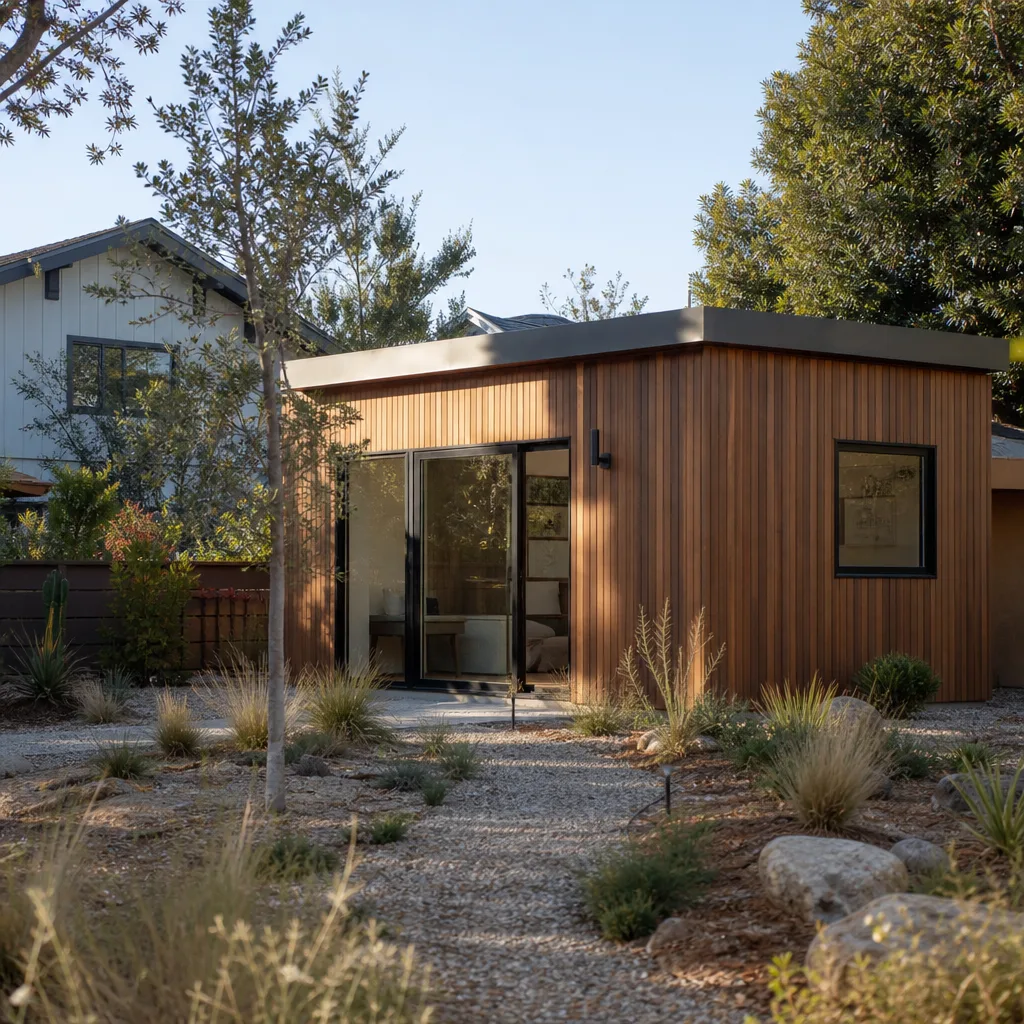
The warning signs that predict a bad ADU experience in Pasadena are visible early, if you know what to look for. Allowance-based contracts, vague permit promises, plans without parcel-specific setback math, unverifiable prefab brand claims, and a refusal to put pricing in writing are all signals that the final bill will be higher and the finished unit will be lower quality than promised. The fix is simple: demand written line-item pricing, verify every claim, and choose a builder who treats transparency as a standard, not a favor. For more guides & resources on planning your Pasadena ADU, visit our blog. At Benson ADU Pasadena, that standard is the Relay Visibility Guarantee, and it’s in writing on every project we build. Call (626) 658-3527 for a free estimate and see the difference a written price makes.
Written by Troy Eastman, Owner at Benson ADU Pasadena, serving Pasadena since 2006.