Last updated October 15, 2026
ADU Permits, Codes & Inspections in CA: What You Need to Know
California law says cities must approve or deny an ADU permit within 60 days. But that clock doesn’t start until the application is deemed “complete,” a distinction Pasadena’s Building & Safety office uses that can add weeks before day one even begins. If you’re planning to add a unit to your property, you’ve probably already hit the wall of conflicting information online: state mandates, local amendments, fee schedules that live in five different PDFs, and inspection sequences no FAQ page explains in order. This guide is the sequence we walk through with Pasadena homeowners every month: the actual permits, the codes that shape your design, the fees nobody quotes until you’re mid-application, and the inspection checkpoints where most projects stall. For The Complete Guide to ADU in Pasadena, see our expanded resource.
Quick Answer
In Pasadena, an ADU requires building permits from the city’s Building & Safety division, compliance with the 2022 California Residential Code (plus local amendments), and a series of inspections at foundation, framing, rough plumbing/electrical/mechanical, insulation, and final stages. Expect city fees between $3,500 and $9,000 for a standard detached unit, plus school and park impact fees that many calculators omit. The process is ministerial for most single-family lots, meaning no hearing or discretionary review, and prefab ADUs from brands like Dvele can streamline inspections through factory certifications. The single biggest mistake is starting design or site work before confirming which local overlays apply to your specific parcel in Pasadena. For a deeper look at what can go wrong, read our ADU Warning Signs: A Pasadena Homeowner’s Reference Guide.
Table of Contents
- State Law vs. Local Rules: What Actually Governs Your ADU
- Pasadena Permit Fees: The Full Schedule, Including What Calculators Miss
- Ministerial vs. Discretionary Review: When Design Review Still Applies
- The Permit Application Sequence, Step by Step
- Every Inspection Stage in Order: Foundation to Final
- Prefab ADUs: How Factory Inspections Reduce On-Site Load
- AB 2221 and ‘Deemed Approved’: What Happens When a City Misses the Deadline
- Common Mistakes to Avoid
- When to Call a Professional
- Frequently Asked Questions
- The Bottom Line
State Law vs. Local Rules: What Actually Governs Your ADU
California’s ADU reform package, passed in waves from 2016 through 2023, was designed to strip away the layers of discretionary review that made ADUs nearly impossible to build in many cities. State law now says: if your lot is zoned single-family or multi-family residential, you have the right to build at least one ADU. Cities cannot require new parking for ADUs located within a half-mile of public transit. Cities cannot impose minimum lot sizes. Setbacks for detached ADUs are capped at four feet for side and rear yards. A JADU, or Junior Accessory Dwelling Unit, can be created from existing space inside the primary home, with a maximum of 500 square feet and no separate bathroom requirement beyond an efficiency kitchen.
What state law does not do is remove the permit requirement itself. You still need a building permit. You still need to meet California Building Code (CBC), California Residential Code (CRC), California Electrical Code, California Plumbing Code, California Mechanical Code, and California Energy Code. Pasadena has adopted these with local amendments through Municipal Code Title 14. We tell every homeowner the same thing: state law defines your rights, but the city interprets them. Pasadena’s zoning map is older than some of the state ADU statutes, and parcel-by-parcel quirks remain: a pre-existing nonconforming setback, a utility easement, or a flood zone designation can all change what’s buildable. What you can build is rarely the question in 2026. What the city will sign off on, in what order, for exactly how much, is where we spend our time.
Since 2020, Pasadena has processed hundreds of ADU applications. The city’s planning department has largely shifted to a ministerial checklist model, which is good news. But the Building & Safety review still looks hard at structural plans, Title 24 energy calculations, and sewer lateral capacity. If your ADU is attached to the main house, you’re also triggering fire separation requirements, which in practice means a one-hour wall assembly between units. If you’re converting a garage, the city will want to see how the slab handles the new use. We’ve been through enough Pasadena plan checks to know where clarifications get requested, and it’s almost always in three places: energy compliance documentation, foundation details on sloped lots, and sewer capacity for the additional bathroom group. The state framework makes ADUs legal. The local review makes them buildable.
Pasadena Permit Fees: The Full Schedule, Including What Calculators Miss
Here’s the honest answer most homeowners don’t get until their application is in process: Pasadena ADU permits cost between $3,500 and $9,000 in city fees, depending on the square footage, whether the unit is attached or detached, and the valuation of the work. The fees are not a single line item. They’re a stack of individual charges that arrive at different points in the process. We’ll break down what we see on actual Pasadena project files from the 2024-2025 cycle.
The core building permit fee is based on the valuation of construction, calculated per the city’s fee schedule. For a 600-square-foot detached ADU with a construction valuation around $180,000 to $220,000, the building permit fee typically lands between $2,200 and $3,400. An attached conversion of similar size runs slightly lower because valuation is reduced by the existing shell. Beyond the core permit, Pasadena applies plan check fees, generally 65% of the permit fee, and microfilming/records fees in the $50 to $75 range. Then come the charges most online calculators omit:
- School impact fees: Pasadena Unified School District levies these on new residential square footage. For ADUs under 750 square feet, the fee is waived under state law. For units between 750 and 1,200 square feet, expect approximately $1.50 to $2.00 per square foot. Over 1,200 square feet, the full school fee applies, which we’ve seen at $4.08 per square foot in recent Pasadena projects.
- Park and recreation fees: Not applicable to most ADUs under state exemption, but Pasadena has applied them to larger detached units in specific cases, so budget $0 to $800 depending on your square footage and parcel.
- Utility connection permits: Pasadena Water and Power (PWP) charges for water service connection, sewer lateral connection, and any meter upgrade. A new water meter for a detached ADU runs $1,500 to $3,500 if your existing meter can’t handle the added load. Sewer lateral permits from the Public Works department typically add $300 to $600. PWP electrical service upgrades, if your panel can’t support the ADU, can add another $1,000 to $3,000.
- Grading permit (if applicable): On hillside parcels in Pasadena, any cut or fill over a certain threshold triggers a grading permit and a soils report requirement. That’s $2,000 to $5,000 before a single inspection happens.
- Fire sprinkler requirements: Pasadena enforces fire sprinkler requirements for ADUs in certain high fire hazard zones, particularly in the hillside areas north of the 210 freeway. A residential sprinkler system for a 600-square-foot ADU adds $3,000 to $6,000 in construction cost and requires a separate fire department plan review.
The total fee picture changes based on where in Pasadena your property sits. A flat-lot single-family parcel south of the 210 with a 500-square-foot conversion can clear the permit process for under $4,000 in city fees. A hillside parcel with grading, fire sprinklers, and a new water meter can push past $9,000 before construction even begins. We include all of these fees in our written estimate. When you get a price from ADU builders in Pasadena, ask specifically whether the number includes city fees, school fees, and utility connection costs. Many contractors quote “construction only” and leave the municipality’s bill to you as a surprise line item.
Ministerial vs. Discretionary Review: When Design Review Still Applies
The single most important legal concept in California ADU permitting is the distinction between ministerial and discretionary approval. A ministerial approval means the city must approve your permit if it meets the objective standards in the code. No hearing, no neighborhood input period, no design review board. State law now mandates ministerial processing for most ADU applications, and Pasadena has complied. A standard detached ADU on a flat lot zoned single-family residential gets ministerial review. The permit processor checks zoning compliance, plan check reviews the structural and energy documents, and the permit issues when everything clears.
But discretionary review hasn’t disappeared entirely in Pasadena. Two triggers remain. First, if your property is on the city’s Historic Register or located within a designated historic district, the city’s Design Commission may still review your ADU for compatibility. That process adds 60 to 120 days and requires design drawings that address context, materials, and visibility from the street. A historic district designation in Pasadena is not unusual; the city has several designated districts, including portions of Bungalow Heaven, Garfield Heights, and neighborhoods surrounding the Civic Center. If your house was built before 1930, check the city’s historic resources map before you start designing.
Second, hillside parcels trigger additional review. Pasadena’s Hillside Ordinance, codified in the zoning code, imposes grading limitations, height restrictions, and vegetation protection standards on properties in the Arroyo Seco and San Rafael Hills areas. An ADU on these parcels may require a hillside development permit, which is discretionary. Slopes over 25% grade make even a standard prefab unit a custom engineering project: retaining walls, pier and grade-beam foundations, and drainage plans that route water without impacting downhill neighbors. We’ve built in these zones, and we can tell you the planning conversations are longer and more technical. If you’re buying a Pasadena property specifically to add an ADU, pull the parcel’s zoning designation and overlays before closing. A quick call to our office at (626) 658-3527 and we can walk through what your specific parcel is likely to trigger. It’s free information that can save you six months of redesign.
The Permit Application Sequence, Step by Step
The Pasadena permit process for an ADU follows a repeatable sequence. Here’s the actual order, based on the applications we file with the city multiple times a month.
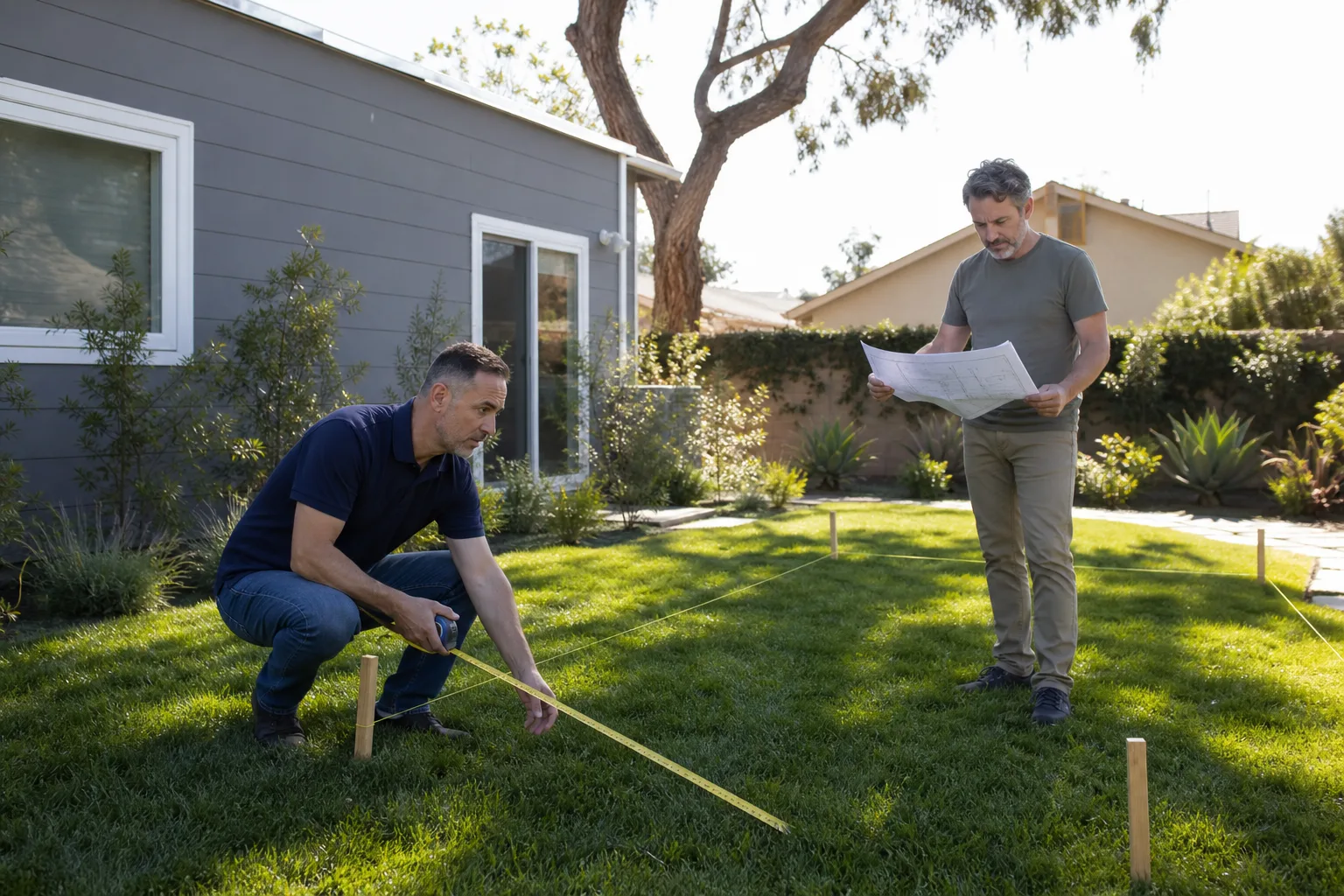
- Pre-application parcel check. Before you spend money on drawings, confirm the zoning designation, any historic or hillside overlays, flood zone status, and sewer lateral capacity. The city’s planning counter can provide this in a single visit or call. We typically do this as step one for every Pasadena client, because it takes an hour and can redirect the entire design.
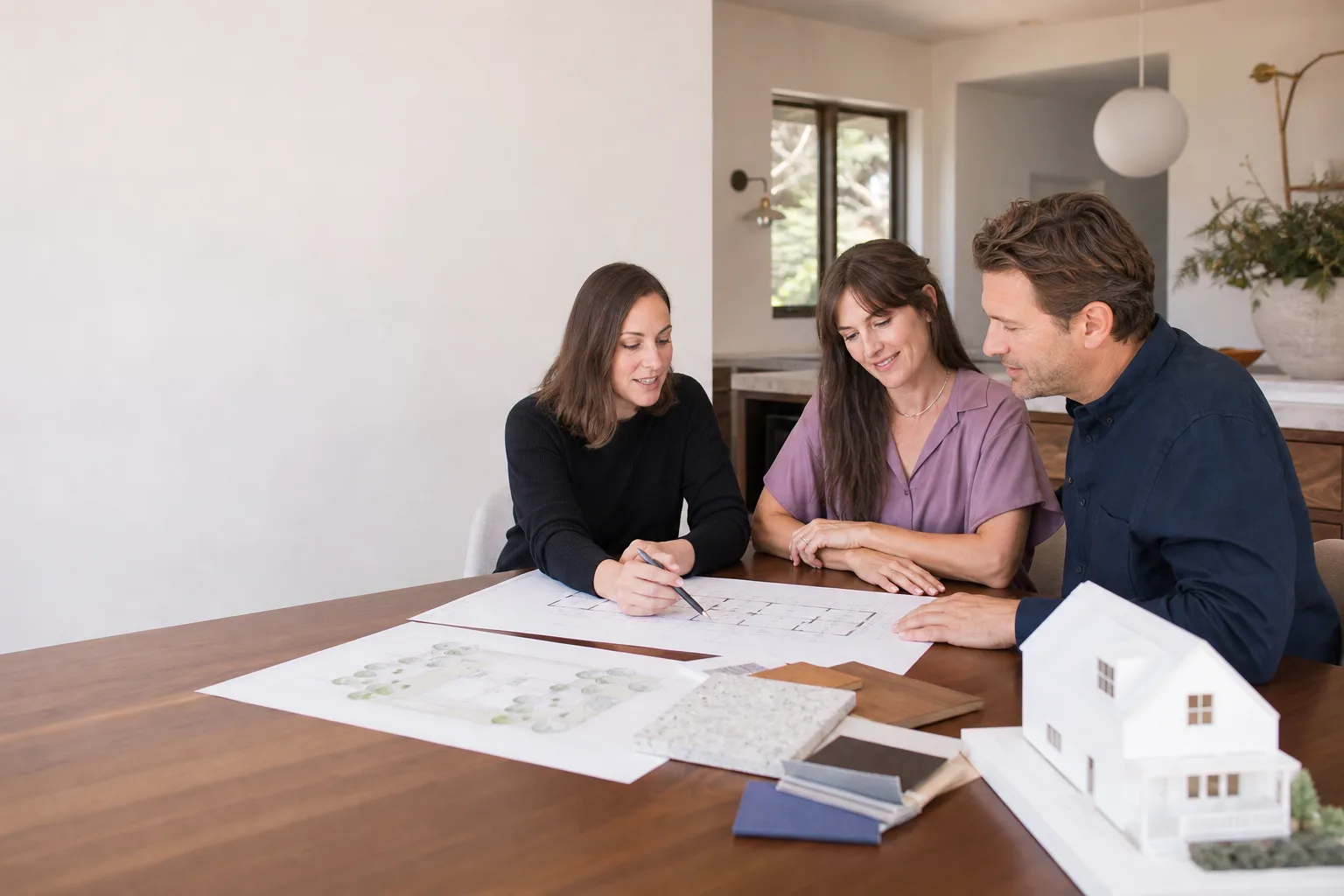
- Site and architectural drawings. You need a dimensioned site plan showing existing structures, property lines, setbacks, and the new ADU location. You need floor plans, elevations, foundation plans, and a Title 24 energy report. For prefab units from Dvele or Mighty Buildings, the factory provides the engineering package, and our team handles the site-specific adaptation.
- Plan check submittal. The application package goes to Building & Safety through the online portal or in person at 175 N. Garfield Avenue. The city reviews structural, energy, plumbing, electrical, and mechanical plans in a single consolidated plan check. First-round comments typically come back in two to four weeks.
- Plan check corrections. Almost every application gets comments. Common Pasadena corrections: Title 24 compliance documentation not matching the plans, missing shear wall details, incomplete sewer lateral calculations, or missing fire separation details on attached units. You respond with revised drawings and documentation.
- Fee payment. Once plans are approved, the city calculates the full fee stack and issues the permit. Payment happens before the permit is released. This is the moment where knowing your full fee picture matters; the invoice arrives in one lump sum.
- Permit issuance. The permit is issued, posted at the job site, and the inspection sequence begins.
The entire application sequence, from parcel check to permit issuance, typically takes 10 to 16 weeks in Pasadena for a standard project. Historic review, hillside review, or unusual site conditions extend that. The state’s 60-day clock is real, but it only runs once the application is deemed complete. In practice, the “complete” determination happens when the plan checker signals that all required documents have been submitted and meet the minimum threshold for review. That’s the distinction we flagged at the top of this guide, and it’s the one that catches homeowners off guard. We manage this timeline continuously with each Pasadena client. That’s part of what you’re buying when you work with an established home addition contractor in Pasadena: someone who knows the process cold and won’t lose weeks to avoidable corrections.
Every Inspection Stage in Order: Foundation to Final
Once the permit is issued, the inspection sequence for a site-built or partially site-built ADU in Pasadena follows a fixed order. Each inspection must be requested by phone or through the city’s online portal, typically with 48 hours notice. An inspector visits, checks the work against the approved plans, and either signs off or writes corrections. Here’s the sequence, with the failure points we see most often at each stage.
- Foundation inspection. Before concrete is poured, the inspector checks the formwork, reinforcing steel, anchor bolt placement, and hold-down locations. On hillside Pasadena lots with piers or grade beams, the inspector also verifies depth and bearing. Common failure: missing hold-downs at shear wall locations, or rebar spacing that doesn’t match the structural drawings.
- Framing inspection. After the walls, floors, and roof are framed but before insulation goes in, the inspector checks structural member sizes, shear panel nailing, hold-down installation, and the window and door header details. Common failure: shear panel nail spacing errors. The plans call for 4-inch edge nailing, the crew used 6-inch spacing, and the inspector catches it instantly. It’s a $200 fix if caught early, thousands if hidden behind drywall.
- Rough plumbing inspection. This covers drain, waste, vent, and water supply lines before they’re covered. The inspector checks slope on drain lines, vent termination, and pressure testing on supply lines. Common failure: incorrect drain slope on a converted garage slab where the existing slope didn’t allow proper fall, requiring a re-route or pump system. Pasadena also checks sewer lateral capacity at this stage.
- Rough electrical inspection. Wiring runs, box placement, circuit sizing, and grounding are checked before drywall. Common failure: missing AFCI/GFCI protection, which is required by the 2022 NEC, and oversized circuits feeding an ADU subpanel without proper disconnect.
- Rough mechanical inspection. HVAC ductwork, ventilation, and any gas line work gets checked. Common failure: duct leakage testing documentation missing, or a mini-split system not sized to match the Title 24 energy calculations.
- Insulation inspection. Wall, floor, and ceiling insulation is checked for R-value compliance before drywall covers it. Common failure: wrong R-value installed. Pasadena’s climate zone (Zone 3B for most of the city) requires R-13 walls and R-30 ceilings for typical wood-frame construction. A contractor who guesses instead of reading the energy report gets caught here.
- Drywall inspection (when required). Not every jurisdiction requires this, but Pasadena checks screw spacing and fire tape on attached ADUs where the shared wall requires a one-hour rating.
- Final inspection. The last stop. The inspector verifies all work is complete, all plumbing and electrical fixtures are installed and functional, smoke alarms and carbon monoxide detectors are in place, the water heater meets code, and the unit is ready for occupancy. Common failure: construction debris blocking the electrical panel, missing GFCI covers, a water heater missing its expansion tank, or smoke detectors not interconnected.
Each failed inspection adds a re-inspection fee and, more importantly, days of schedule delay. In Pasadena, we see the highest failure rates at rough plumbing and insulation, which tells you something about where the shortcuts happen in the industry. A room addition contractor in Pasadena who manages inspections aggressively can keep a project moving at full speed; one who treats inspections as an afterthought loses a week at every stage. It matters who’s on the job.
Prefab ADUs: How Factory Inspections Reduce On-Site Load
If you’re planning a Pasadena ADU with a prefab system, the inspection picture changes meaningfully. Prefab ADUs from brands like Dvele and Plant Prefab are built in controlled factory environments, with structural and systems inspections performed by state-certified third-party agencies before the modules ever leave the factory. The California Department of Housing and Community Development (HCD) regulates factory-built housing construction in the state, and Pasadena accepts HCD-approved factory certifications as evidence of compliance for the factory-built portions of the work.
Here’s what that means practically. A Dvele unit arrives at your Pasadena site with structural, electrical, plumbing, and mechanical work already installed and certified. The city’s inspections then focus on the site-specific scope: the foundation the modules sit on, utility connections (sewer, water, electrical service), any site-built components like decks and stairs, and the final overall assembly. Instead of eight inspections, a prefab ADU might require four or five: foundation, utility trench inspection, connection inspection, and final. That reduction is real, and it translates into weeks of saved schedule time.
But prefab inspection documentation matters enormously. The city will ask for the HCD insignia and the factory’s certification documentation for each module. If a homeowner shows up with a prefab unit that lacks proper HCD paperwork, Pasadena can treat the unit as site-built, which means destructive inspections to expose wiring and plumbing, or outright rejection. We tell every Pasadena homeowner considering prefab the same thing: confirm the manufacturer’s HCD certification status before you sign a contract. Dvele, Mighty Buildings, Boxabl, and Plant Prefab all have the necessary certifications for California, but the documentation has to match the exact unit and configuration you’re buying. Our team handles that paperwork as part of the permit application. We’ve built with Dvele and other prefab brands enough times to know exactly which documents Pasadena’s plan checkers will request and in what order they want them presented.
Prefab also changes the site work picture. The foundation has to be nearly perfect, because a module built to a half-inch tolerance doesn’t flex to accommodate a sloppy stem wall. In Pasadena, where many lots have hillside conditions or expansive soils, that means a foundation plan that accounts for precise module dimensions and anchoring points. Prefab isn’t the right choice for every parcel, but for flat lots and standard residential zones in Pasadena, it’s often the fastest permitted path to a finished unit.
AB 2221 and ‘Deemed Approved’: What Happens When a City Misses the Deadline
AB 2221, signed in 2022 and effective in 2023, strengthened California’s ADU approval requirements in a specific and important way. The law states that if a city fails to act on a completed ADU application within the required timeframe (60 days for a standard ADU, 30 days for a JADU), the application is “deemed approved.” That’s not a suggestion. It’s a statutory default: no action equals approval.
Here’s the catch, and it’s a significant one in Pasadena. The deemed approved provision only applies once the application is deemed complete. If the city hasn’t issued a completeness determination, the clock hasn’t started. Pasadena issues completeness determinations, and the city’s planning and building staff has been diligent about doing so in writing. But if you’ve submitted a complete package and the city goes silent past the 60-day mark, you have a legal right to treat the permit as approved and proceed, subject to the building permit still being issued. In practice, the deemed approved provision works as a leverage tool: a letter from your representative citing AB 2221 typically breaks the logjam quickly. We’ve never had to invoke the deemed approved clause with Pasadena, but we track the submission dates on every application and flag any that approach the statutory deadline. When you’re working with a builder who files multiple permits monthly, the city’s rhythm becomes predictable. When you’re a homeowner filing your first application, the silence can feel like limbo. It isn’t, and knowing the law changes your posture in the conversation.
One more provision in AB 2221 worth knowing: it clarified that front setbacks can be modified for ADUs when the local agency imposes a front setback that exceeds the four-foot standard from prior state law, and it reinforced that no owner-occupancy requirement can be imposed on ADUs for a period that exceeds what’s permitted under state law. For Pasadena homeowners, the practical upshot is that the city cannot require you to live in the main house or the ADU under most circumstances. If you’re building a rental unit, that matters for your financing model. If you’re building for family, it’s one less complication.
Common Mistakes to Avoid
- Starting design work before checking parcel overlays. In Pasadena, we’ve seen beautiful ADU plans come back from architects with a historic district ignorance that kills the project. Check the city’s zoning and historic resources maps first. Fifteen minutes of research saves months of redesign.
- Assuming state law erases local fees. State law creates the right to build. It does not waive Pasadena’s permit fees, school fees (above 750 square feet), or utility connection charges. Budget for them from day one and the project stays financially sane.
- Signing a construction contract that excludes city fees. If the number on your contract doesn’t include permits, plan check, school fees, and utility connections, you’re signing up for a surprise invoice. Our written estimates include the full fee stack. Yours should too, whoever builds it.
- Choosing a foundation approach that ignores Pasadena soil conditions. Parts of Pasadena have expansive clay soils and significant slope. A standard slab accepted in other Southern California cities won’t pass plan check here without soils-specific engineering. Your plans have to match your parcel.
- Buying a prefab ADU without HCD documentation. The unit may be beautiful. Without proper HCD certification paperwork, Pasadena can’t accept it as factory-built, and your inspection process resets to site-built standards. Confirm documentation before purchase.
- Skipping the sewer lateral capacity check. Adding a second kitchen and bathroom to a property with an aging 4-inch lateral on a shared line can trigger Public Works requirements you didn’t plan for. We check this in our pre-application process.
- Treating the 60-day clock as a guarantee. In Pasadena, as in every California city, the clock runs from completeness, not submission. File a complete package, get the completeness determination, and then hold the city to the statute.
When to Call a Professional
If your Pasadena parcel triggers a historic district review, hillside ordinance compliance, or a grading permit, a professional is not optional. See our DIY vs Professional ADU: The Pasadena Homeowner’s Decision Guide to weigh your options. The documentation requirements are detailed, the review timelines are long, and unforced errors cost months. If you’re placing a prefab ADU, the foundation specification, HCD paperwork, and connection sequencing require someone who’s done it multiple times. And if you simply value your time, the permit process is a series of precise, document-driven steps where experience translates directly into calendar weeks saved. Benson ADU Pasadena offers free estimates in Pasadena, and our written price includes the full permit fee stack before any work begins. Call (626) 658-3527 and we’ll walk your specific parcel through the process, step by step, starting with the parcel check that costs nothing and tells you everything.
If you’re still in the research phase, start with our Benson ADU Pasadena home page for an overview of what we do, or read more about our ADU building process in Pasadena to see how the permit sequence fits into the broader construction timeline.
Frequently Asked Questions
Pasadena ADU permits cost between $3,500 and $9,000 in total city fees for a standard detached or attached unit, including the building permit, plan check fees, school impact fees (if over 750 square feet), and utility connection permits. Your exact number depends on square footage, valuation, and whether your parcel triggers grading or fire sprinkler requirements. Call (626) 658-3527 for a written estimate that includes the full fee stack.
Standard ADU permit approval in Pasadena takes 10 to 16 weeks from submittal to issuance, assuming the plans pass plan check with minimal corrections. The state-mandated 60-day clock only begins once the city deems the application complete. Historic or hillside review extends the timeline significantly.
Yes. State law prohibits California cities from imposing minimum lot sizes for ADUs, and Pasadena complies. The limiting factors on small lots are the four-foot setback requirements, the maximum lot coverage under zoning, and the practical buildable area left after accounting for the main house, existing driveways, and utility easements. A site-specific feasibility check settles the question.
Most Pasadena ADUs do not require fire sprinklers, but units in high fire hazard zones in the hillside areas north of the 210 typically do, and attached ADUs may trigger the requirement based on the main house’s existing sprinkler status. Your parcel’s fire zone designation determines the answer, and we confirm this during the pre-application check.
Prefab ADUs from brands like Dvele can reduce on-site inspection stages from eight to four or five, because factory-certified HCD inspections cover the structural and systems work before delivery. The permit timeline is similar to site-built, but construction time on-site is typically cut by months. Documentation must match the exact unit configuration.
Under AB 2221, a completed ADU application not acted on within 60 days is deemed approved by operation of law. The key language is “completed”: the clock starts when the city issues a completeness determination, not when you submit. If the city goes silent past the deadline, a letter citing the statute typically resolves the delay quickly.
The Bottom Line
California law made ADUs possible. Pasadena’s local process makes them real, with a specific fee schedule, a sequential inspection path, and parcel-level overlays that determine how smoothly the project runs. The homeowners who succeed are the ones who front-load their research: check the parcel, understand the fee stack, know the ministerial versus discretionary distinction, and either contract a builder who files these permits regularly or prepare to learn the process themselves. Time is the real hidden cost, and permits are where time gets spent. Get the parcel check done first, and everything that follows gets clearer. Browse more guides & resources for Pasadena ADU projects.
Written by Troy Eastman, Owner at Benson ADU Pasadena, serving Pasadena since 2006.